Medically reviewed by Dr. Prem Ratan Degawat, MD, DM (Cardiology)
Senior Interventional Cardiologist · Director, Mitral & Tricuspid Valve Therapy · Associate Director, TAVR & Structural Heart Disease Program, Eternal Hospital, Jaipur
Last updated on Oct 8, 2026 · View LinkedIn profile
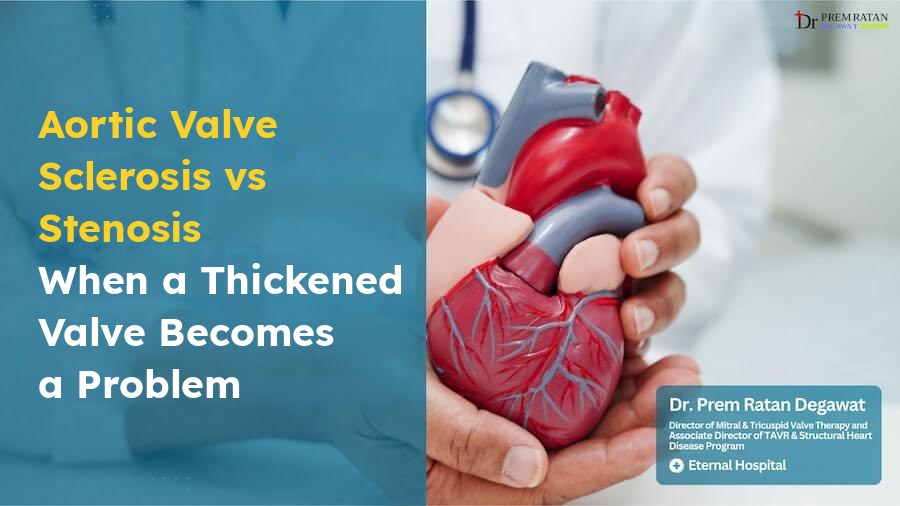
Aortic valve sclerosis means the aortic valve has thickened or picked up some calcium, but it still opens well and blood flows through it normally. It is not aortic stenosis, and it does not need a valve procedure. It does deserve attention, for two reasons: a small share of sclerotic valves narrow over the years, and sclerosis is linked with a higher risk of heart attack and stroke.
If your echo report says “aortic valve sclerosis”, “sclerosed aortic valve” or “AV thickened, opening normal”, this article explains what it means and what to do next.
| Aortic valve sclerosis | Aortic stenosis | |
|---|---|---|
| Valve leaflets | Thickened, may have spots of calcium | Thickened and stiff, often heavily calcified |
| How the valve opens | Normally, or close to it | Restricted, the opening is narrowed |
| Symptoms caused by the valve | None | Possible, once it becomes severe |
| What you do now | Repeat echo, control heart risk factors | Regular echo, timing of valve replacement |
What does aortic valve sclerosis actually mean?
The aortic valve sits between the heart’s main pumping chamber and the aorta, the large artery to the body. Its three thin flaps, called leaflets, open with each heartbeat and close to stop blood flowing back.
With age, these leaflets can thicken. Small deposits of calcium settle on them. On an echo, they look brighter and thicker than a young person’s valve. That is sclerosis.
The key word is “still”. The leaflets are thicker, but they still swing open fully. The echo measures how fast blood moves through the valve, and in sclerosis that speed stays close to normal. Nothing is blocked.
It is very common. In the Cardiovascular Health Study, which followed older Americans for years, Otto and colleagues found sclerosis in 29% of 5,621 people aged 65 or above. A 2014 review of 22 studies by Coffey and colleagues found it in 9% of people in a study with an average age of 54, rising to 42% in a study with an average age of 81.
How is it different from aortic stenosis?
Aortic stenosis is the next stage. The leaflets become stiff enough that they no longer open fully. Blood has to squeeze through a smaller opening, so it speeds up, and the heart has to push harder.
The echo draws the line using that speed, the pressure difference across the valve and the area of the opening. When those numbers move out of the normal range, the report changes from “sclerosis” to “mild aortic stenosis”. Our Hindi guide to reading an echo report for aortic stenosis lists the exact cut-off for each grade.
Sclerosis is the early, silent stage of the same disease. Not everyone moves on from it, and those who do usually take years.
Is aortic valve sclerosis dangerous?
On its own, no. The valve is working, and sclerosis does not cause breathlessness, chest pain or fainting. If you have those symptoms, the cause lies elsewhere and still needs finding.
The concern is what sclerosis signals. There are two separate risks.
Risk 1: it can progress to stenosis
Most sclerotic valves never become a problem. Some do. The Coffey review found that 1.8% to 1.9% of people with sclerosis developed aortic stenosis each year.
In a study by Cosmi and colleagues of 2,131 patients with a thickened valve, 15.9% developed aortic stenosis. Severe stenosis developed in 2.5%.
Those numbers cut both ways. A small yearly rate is reassuring. Over 10 or 15 years it adds up, so one reassuring echo at 65 is not the end of the story.
Risk 2: it is a marker of heart and artery disease
In the Otto study, people with sclerosis had about a 50% higher risk of dying from heart disease and of having a heart attack over five years than people with normal valves. That held even after allowing for age and sex, and again after allowing for other risk factors.
The Coffey review found the same pattern: a 68% higher risk of coronary events, 27% higher risk of stroke and 69% higher risk of death from heart disease.
Why would a working valve carry that risk? The calcium on the valve builds up through a process much like plaque in the arteries. The valve is not causing heart attacks. It is a visible sign that the same process may be at work in the coronary arteries.
What raises the chance of progression?
In the Cardiovascular Health Study, Stewart and colleagues found that the factors linked with sclerosis look a lot like coronary risk factors:
- Age, with roughly double the risk for every 10 years
- Male sex, about twice the risk
- Current smoking, about 35% higher risk
- High blood pressure, about 20% higher risk
- High LDL cholesterol and high lipoprotein(a), a genetic form of cholesterol
The Cosmi study added one echo finding: calcium in the ring of the mitral valve (mitral annular calcification) was the only factor that independently predicted progression to stenosis in that group.
Two other causes of a “thickened” valve matter in India. A valve with two leaflets instead of three, a bicuspid aortic valve, tends to thicken and narrow 10 to 20 years earlier than a normal one. Old rheumatic fever can also thicken the aortic valve, usually alongside changes in the mitral valve. In Rajasthan I still see both. When a report mentions sclerosis in someone under 50, I check whether the valve has two leaflets or three, and whether there are rheumatic changes.
What should you do if your echo shows aortic sclerosis?
No medicine is needed for the valve itself. Look after the rest of your heart, and keep an eye on the valve.
Treat the risk factors that matter for your arteries. Keep blood pressure in the range your doctor sets. Stop smoking completely. Control diabetes. Get your cholesterol checked. I do not prescribe a statin for the valve, but I do prescribe one when the overall heart risk calls for it.
Get a repeat echo. There is no single guideline interval for sclerosis alone. When the valve is otherwise fine and the person has no symptoms, I usually repeat the echo after about two to three years. I bring it forward if the doctor hears a new or louder murmur, or if the valve has two leaflets.
Know the symptoms that should bring the visit forward. Do not wait for the scheduled echo if you notice:
- Breathlessness on walking or climbing stairs that is new or getting worse
- Chest tightness or heaviness during effort
- Dizziness, light-headedness or fainting during or just after effort
I do not ask patients with sclerosis alone to cut back on walking or exercise. The valve is not narrowed, so there is no reason to restrict yourself.
When I see a patient with sclerosis in the OPD, the valve is usually the shortest part of the conversation. I listen for the murmur and look at the echo for the leaflets and the mitral ring. Then I spend most of the time on blood pressure, cholesterol, sugar, smoking. That is where the real risk sits.
What does not work?
Nothing reverses calcium on a heart valve. No diet, supplement or ayurvedic preparation has been shown to dissolve it. Be wary of anyone who promises otherwise.
Statins are the obvious question, and they have been tested. In the SALTIRE trial, 155 patients with calcific aortic stenosis took high-dose atorvastatin or a placebo. LDL cholesterol fell by more than half on the statin, yet the valve narrowed at the same speed in both groups.
The larger SEAS trial gave 1,873 patients with mild or moderate stenosis either simvastatin plus ezetimibe or a placebo. Valve replacement was needed just as often in both groups. But the treated group had fewer heart attack-type events (148 against 187 patients).
That is the honest summary. A statin will not protect your valve. It may protect your arteries, which is the reason to take one when your doctor advises it. These trials were in stenosis, not sclerosis, and no trial has shown any medicine stops sclerosis from progressing.
When should you see a structural heart specialist?
Sclerosis alone does not need a TAVI specialist. I tell patients this plainly: you will not be offered a valve procedure for sclerosis, and you should not be.
See a structural heart cardiologist if:
- A later echo shows the valve has moved into mild, moderate or severe aortic stenosis
- The valve has two leaflets, or there are rheumatic changes
- You develop any of the symptoms listed above
If stenosis does develop and becomes severe, the treatment options include surgical valve replacement and TAVI, a valve replacement through a tube in the leg artery. Our guide to aortic stenosis symptoms and treatment covers that stage in detail, and the TAVI eligibility guide explains who qualifies. Most people with aortic valve sclerosis will never need either.
To have your echo reports reviewed, you can book a consultation with Dr. Prem Ratan Degawat in Jaipur.
About Dr. Prem Ratan Degawat
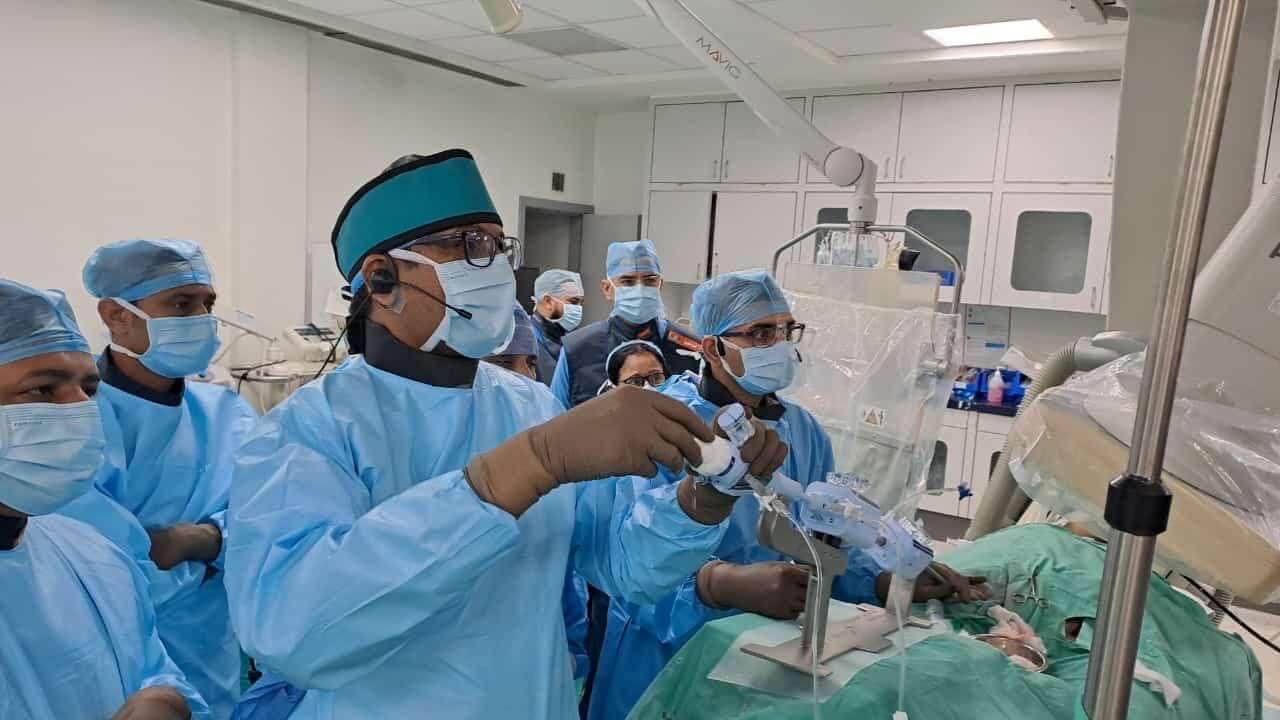
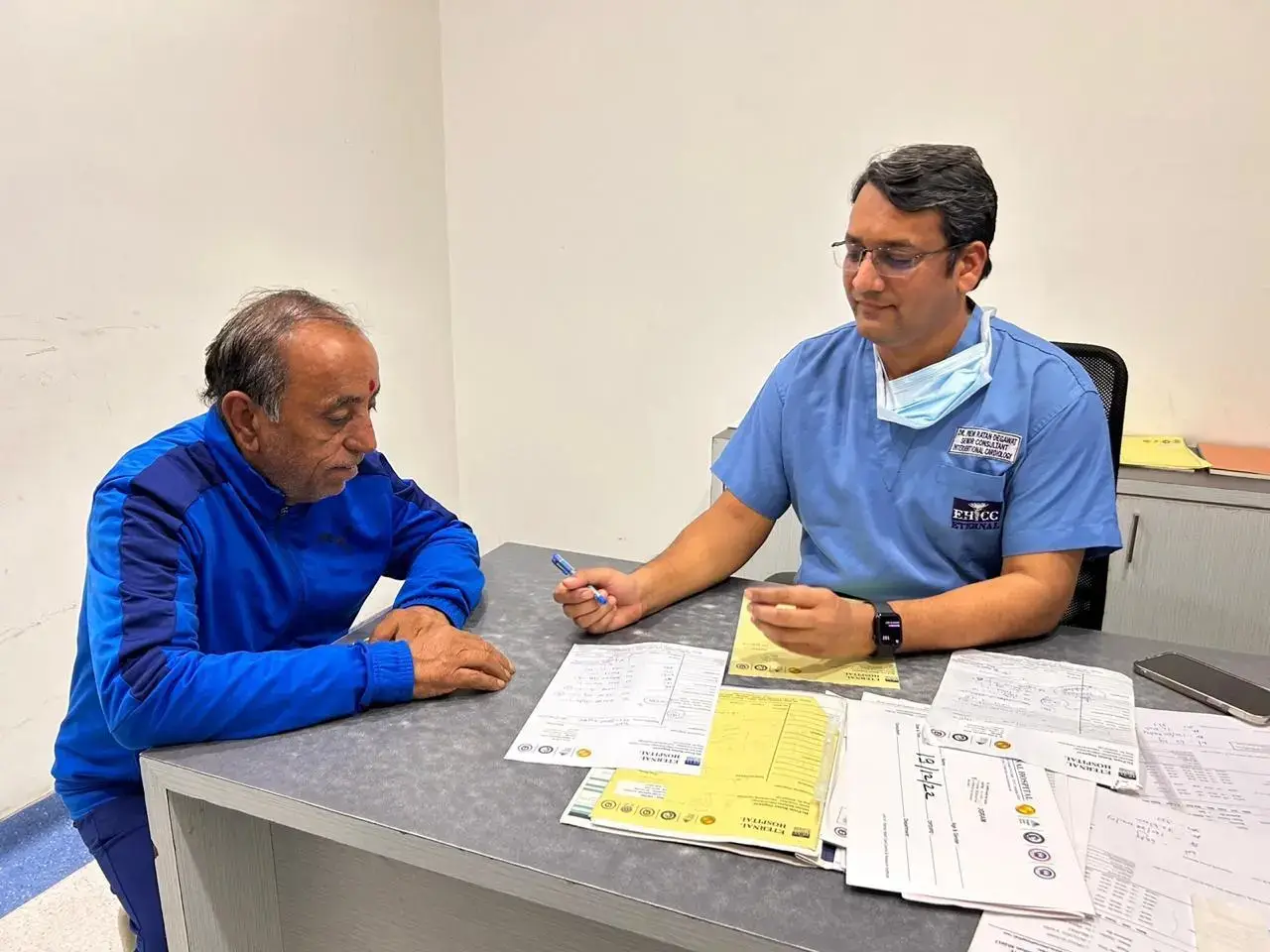
Dr. Prem Ratan Degawat is Associate Director of the TAVR & Structural Heart Disease Program and Director of the Mitral & Tricuspid Valve Program at Eternal Hospital, Jaipur.
He completed his DM in Cardiology at King George’s Medical University, Lucknow, and trained in advanced structural heart intervention at IRCCS Humanitas, Italy.
- Clinic: 6/384, In front of Railway Headquarter, Sector 6, Malviya Nagar, Jaipur, Rajasthan 302017
- Hospital for procedures: Eternal Hospital, 3A Jagatpura Road, Near Jawahar Circle, Jaipur 302017
- OPD: Monday to Saturday, 10:00 AM to 4:00 PM
- Contact: +91-8960594076
FAQs
Is aortic valve sclerosis dangerous?
The sclerosis itself does not harm the heart, because the valve still opens normally. It matters for two reasons. A small share, about 2% a year in pooled studies, progress to aortic stenosis. It is also linked with a higher risk of heart attack and stroke, so your other heart risk factors need attention.
Can aortic valve sclerosis be reversed?
No. Calcium on the valve does not dissolve with diet, supplements or medicines. Statins lower cholesterol but did not slow valve narrowing in the SALTIRE and SEAS trials. What you can change is your overall heart risk, which is where most of the danger linked with sclerosis lies.
Does aortic sclerosis need surgery or TAVI?
No. Surgery and TAVI are for severe aortic stenosis, usually with symptoms. Sclerosis means the valve still opens normally, so there is nothing to replace. If a later echo shows the valve has narrowed to a severe degree, the question of valve replacement comes up then.
How often should I repeat the echo?
There is no fixed guideline interval for sclerosis alone. For a three-leaflet valve with no symptoms, I usually repeat the echo after two to three years. It should be sooner if a new murmur is heard, the valve has two leaflets, or you develop breathlessness, chest tightness or dizziness on effort.
What is the difference between aortic sclerosis and mild aortic stenosis?
In sclerosis the leaflets are thickened but open normally, and blood moves through the valve at near-normal speed. In mild stenosis, the opening has started to narrow and the speed of blood through it has risen above normal. The echo report states which one it is, based on measured numbers.