Medically reviewed by Dr. Prem Ratan Degawat, MD, DM (Cardiology)
Senior Interventional Cardiologist · Associate Director, TAVR & Structural Heart Disease Program, Eternal Hospital, Jaipur
Last updated on Sep 5, 2026 · View LinkedIn profile
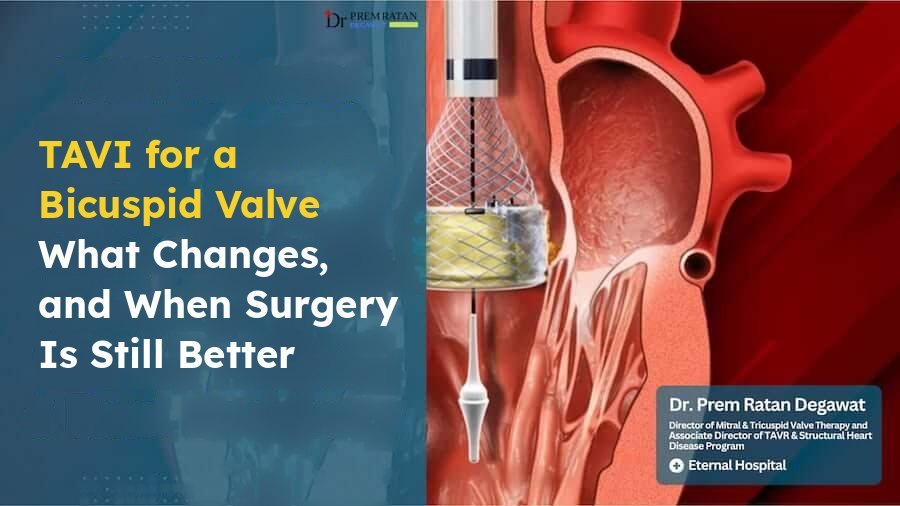
If you have been told your aortic valve is bicuspid and that this complicates a TAVI, the short answer is that it complicates the planning, not the possibility. Most bicuspid patients who need their valve replaced can have it done through the leg, without opening the chest. The anatomy changes how carefully the valve has to be sized and chosen, and in some patients it still tips the decision toward surgery.
Here is the honest summary before the detail.
| Question | Short answer |
|---|---|
| Can a bicuspid valve be treated with TAVI? | Usually yes, with careful CT planning |
| Is it riskier than a normal three-leaflet valve? | In low-risk patients, registry outcomes are close to the same |
| Does it rule out TAVI? | No, but some anatomy and some ages are better served by surgery |
| Is age part of the decision? | Yes, and for younger patients it carries real weight |
What a bicuspid aortic valve actually is
Your aortic valve is the door between the heart and the body. It normally has three leaflets that open and shut with every beat. About one person in every fifty to two hundred is born with only two, which is what bicuspid means. It is the most common condition anyone is born with in the heart, and most people who have it never find out until a scan or a murmur brings it up.
Two leaflets do the same job. They just do it under more strain.
Why a bicuspid valve narrows earlier
A two-leaflet valve opens in a slightly oval shape rather than a clean triangle. The leaflets flex against each other in a way three leaflets do not. Over decades that extra mechanical stress speeds up calcium deposits on the valve.
The practical effect is age. Aortic stenosis in a person with three leaflets usually becomes a problem in the late seventies or eighties. In a bicuspid valve it often arrives ten to twenty years sooner. That is why I see bicuspid patients in their fifties and sixties with severe stenosis, sitting in the clinic looking otherwise fit and healthy, and completely thrown by the diagnosis.
Many of them also have some widening of the aorta just above the valve. That is part of the same condition and it has to be measured, because it sometimes changes the whole plan.
Why bicuspid anatomy used to rule out TAVI
Early TAVI valves were designed around a round opening with three leaflets. Bicuspid anatomy is not round. It is more elliptical, the calcium sits in heavier and more uneven ridges, and there is often a raphe, which is a fused seam where two leaflets joined during development.
That combination caused three problems in the early years. Valves did not always expand evenly. Leaks around the edge of the new valve were more common. And a stiff, heavily calcified ring carried a risk of tearing when the valve was expanded into it.
Those were real concerns, and bicuspid patients were excluded from the trials that first proved TAVI works. Being excluded from a trial is not the same as being harmed by a treatment, but it left a gap in the evidence that took years to fill.
Three things changed. Imaging got better, so the anatomy can now be measured precisely before anyone touches the patient. Newer valve designs seal better against an irregular ring. And operators built up enough bicuspid volume to learn how these cases behave.
What the evidence actually shows now
This is where I want to be careful, because the honest answer has two halves and most pages only give you the first one.
The reassuring half comes from the STS/ACC TVT Registry analysis published by Makkar and colleagues in JAMA in 2021. It matched 3,168 pairs of low surgical risk patients, bicuspid against three-leaflet, all treated with the same balloon-expandable valve. Death at 30 days was 0.9% in the bicuspid group and 0.8% in the other. There was no significant difference in death or stroke at 30 days or at one year, and no difference in how well the valves worked afterwards.
The cautionary half comes from NOTION-2, which randomly assigned 370 younger low-risk patients to TAVI or surgery and followed them for three years. Across the whole trial the results were close. In the patients with three leaflets they were almost identical, 14.5% against 14.4% for the combined outcome of death, stroke or hospitalisation. But in the bicuspid patients the numbers separated: 20.4% after TAVI against 7.8% after surgery. The confidence interval was wide and the difference did not reach statistical significance, so this is a signal rather than a verdict. It is still a signal I take seriously in a 62-year-old.
So the fair summary is that bicuspid anatomy is not a barrier in older patients with suitable anatomy, and remains a genuine open question in younger ones.
How I plan a bicuspid case
A bicuspid TAVI is won or lost on the CT scan, not in the cath lab. Before I commit, I want four things settled.
I measure the annulus and the level just above it separately. In a three-leaflet valve, sizing off the annulus alone is usually enough. In bicuspid anatomy the narrowest point is often higher, at the level of the fused raphe, and a valve sized only to the annulus can sit too large for the space it actually has to open into.
I map where the calcium sits. Heavy calcium on the raphe, especially in a continuous bar, is the pattern most associated with uneven expansion and leaks. When I see it, I size down rather than up.
I measure the aorta above the valve. If it is dilated beyond the point where it needs treating in its own right, then the valve is no longer the whole problem, and an operation that deals with both may serve the patient better than a procedure that deals with one.
I check the height of the coronary arteries. Bicuspid leaflets are often long, and a displaced leaflet can sit across a coronary opening.
Only when those four line up do I talk to the patient about a date. If they do not, I say so, and I explain why. You can read how this fits the wider assessment on our page on who qualifies for TAVI.
When I still recommend open surgery
There are bicuspid patients I do not offer TAVI to, and I would rather say that plainly than pretend the procedure suits everyone.
If you are in your fifties or early sixties and fit for an operation, I will usually put surgery on the table as the first option, and the NOTION-2 bicuspid numbers are the reason. If the aorta above the valve is significantly enlarged, surgery treats both problems in one sitting. If the anatomy is heavily and asymmetrically calcified in a way that suggests the valve will not seat evenly, the catheter route stops being the gentler route. And if the coronary heights are unfavourable, the risk is not worth it.
None of that is a failure of TAVI. It is the reason a heart team exists.
Recovery and what happens afterwards
For a bicuspid patient who is suitable, recovery looks like any other TAVI. Most people are up the next day and home within two to four days, with no chest wound and no sternum to heal.
The durability question matters more here, because bicuspid patients are younger and will live with the valve longer. In NOTION-2 at three years, moderate or worse deterioration of the valve was 4.5% after TAVI and 5.2% after surgery, so the early durability data are reassuring. Three years is still short for a 60-year-old, and I say that openly. We cover this in more detail on how long a TAVI valve lasts.
Which valve gets used is part of the same conversation, and the trade-offs are set out on our page comparing balloon-expandable and self-expanding valves.
Where to start if this is you
Bring your echo report and, if you have one, your CT angiogram. If you do not have a CT yet, that is the scan that will answer most of the questions above. If you are new to the procedure itself, start with what TAVI involves.
Assessment and treatment for bicuspid aortic stenosis are done at Eternal Hospital, Jaipur, as part of our TAVI and structural heart programme. If you are travelling from outside Rajasthan, send your reports ahead so the first visit is useful.
About Dr. Prem Ratan Degawat
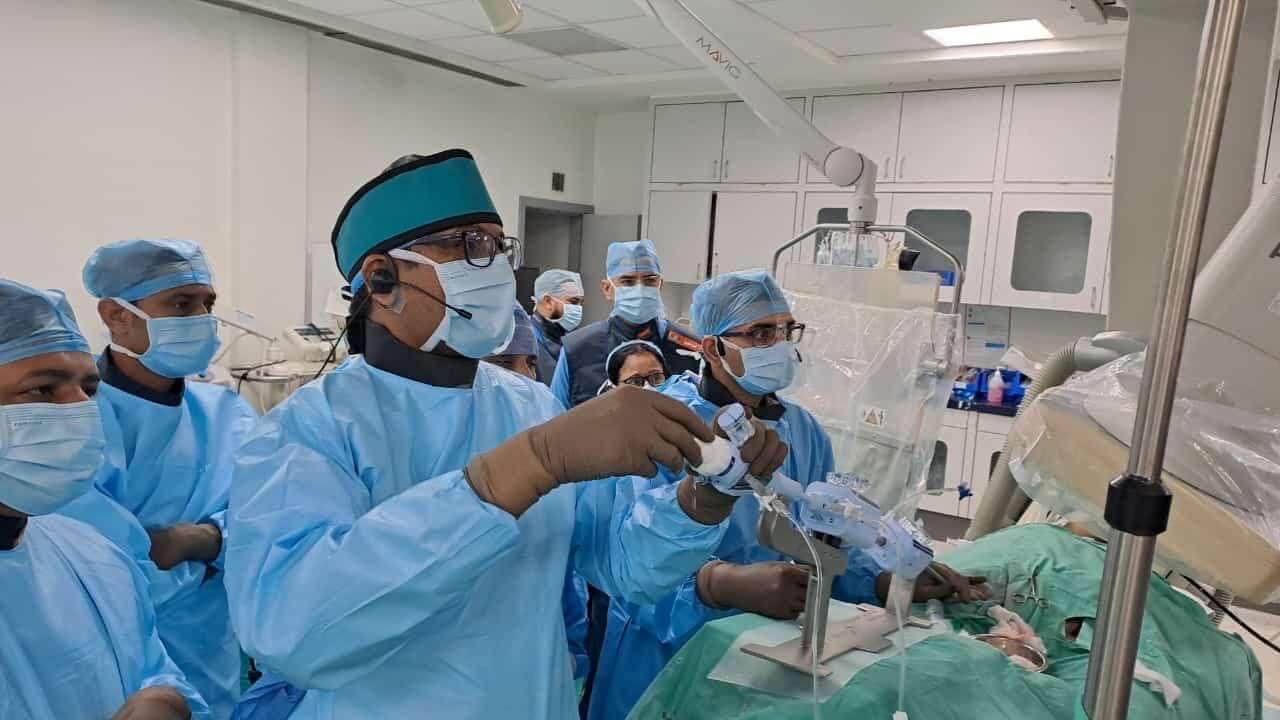


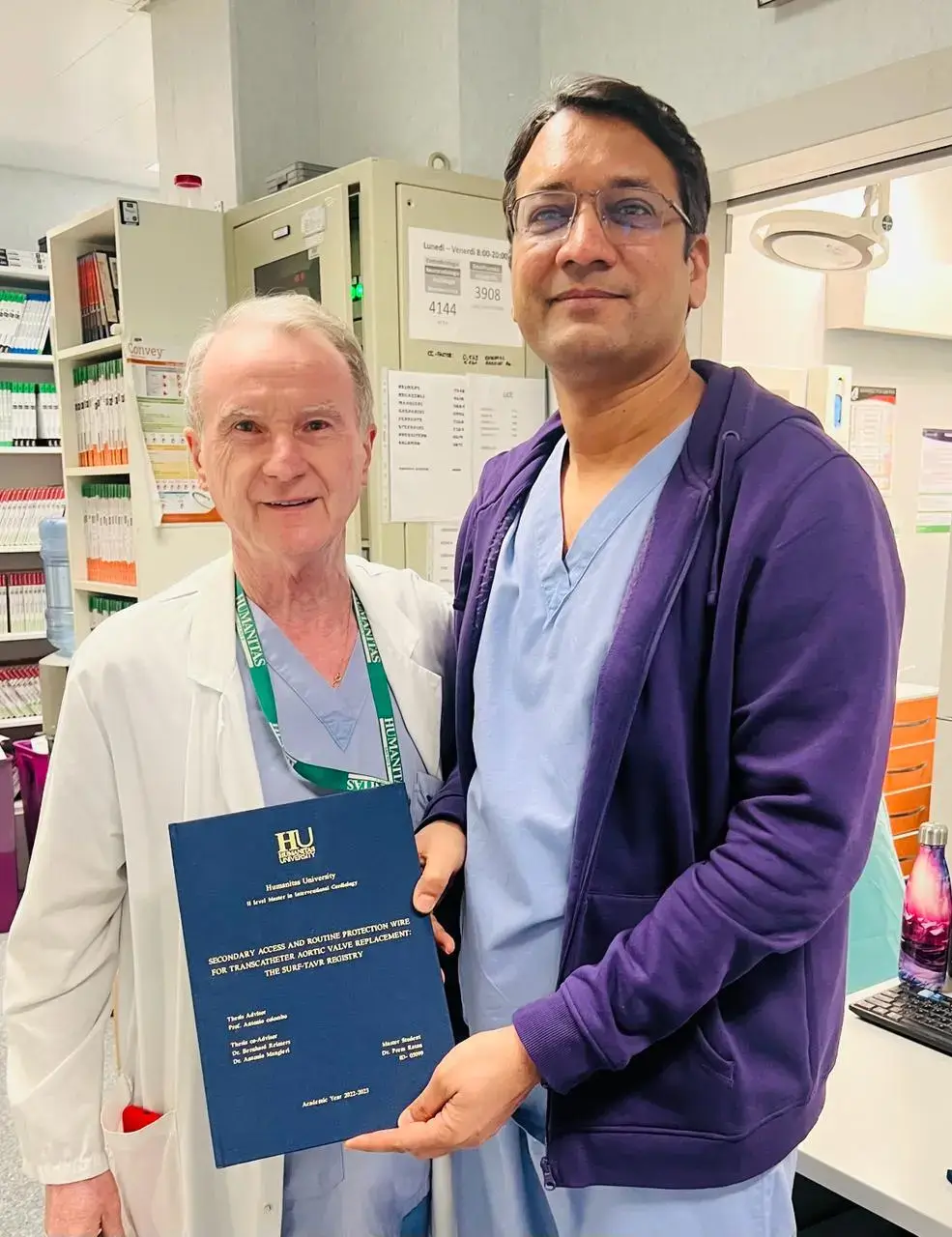
Dr. Prem Ratan Degawat is a senior interventional cardiologist in Jaipur who specialises in structural heart disease. He is Associate Director of the TAVR and Structural Heart Disease Program at Eternal Hospital and has performed more than 600 TAVI procedures, including bicuspid, valve-in-valve, and TAVR-in-TAVR cases.
He completed his DM in Cardiology at King George’s Medical University, Lucknow, and trained in advanced structural heart intervention at IRCCS Humanitas in Italy. He is among a small number of cardiologists in India certified in TAVI, MitraClip, TRI-Clip, and TMVR procedures.
Dr. Degawat is known for explaining conditions and options in plain language, so patients and families can decide with confidence.
Consultation details:
- Hospital: Eternal Hospital, 3A Jagatpura Road, Near Jawahar Circle, Jaipur 302017
- OPD: Monday to Saturday, 10:00 AM to 4:00 PM
- Clinic: 6/384, In front of Railway Headquarter, Sector 6, Malviya Nagar, Jaipur
- Contact: +91-8960594076
FAQs:
Is TAVI safe if I have a bicuspid aortic valve?
In low surgical risk patients, the 2021 JAMA registry analysis by Makkar and colleagues found 30-day death of 0.9% in bicuspid patients against 0.8% in three-leaflet patients, with no significant difference at one year. Safety depends far more on your specific anatomy than on the number of leaflets.
Am I too young for TAVI if my bicuspid valve is failing at 55?
You are not too young for the procedure, but age changes the balance. In the NOTION-2 trial, younger bicuspid patients did better with surgery over three years. For a fit patient in their fifties, I usually recommend discussing surgery first.
Why was my bicuspid valve only found now?
Most bicuspid valves cause no symptoms for decades. They are commonly found when a murmur is heard, or when an echocardiogram is done for something else. Finding it later is normal and does not mean anything was missed.
Does a bicuspid valve mean my children should be checked?
It runs in families more often than a three-leaflet valve does, so first-degree relatives are usually offered a screening echocardiogram. It is a simple, painless scan.
Will I need my aorta treated as well?
Sometimes. Widening of the aorta above the valve is part of the same condition. If it is large enough to need treatment in its own right, that changes the plan and often favours surgery, because both can be dealt with together.
Can a bicuspid valve be repaired instead of replaced?
Repair is possible in selected younger patients, mostly when the valve is leaking rather than narrowed. Once a valve is heavily calcified and narrowed, replacement is the realistic option.