Medically reviewed by Dr. Prem Ratan Degawat, MD, DM (Cardiology)
Senior Interventional Cardiologist · Director, Mitral & Tricuspid Valve Therapy · Associate Director, TAVR & Structural Heart Disease Program, Eternal Hospital, Jaipur
Last updated on April 4, 2026 · View LinkedIn profile
Facing a decision about heart treatment can feel overwhelming. Should you choose angioplasty or bypass surgery? Both procedures can save your life, but they work differently and suit different situations.
Understanding the differences between these treatments helps you make the right choice for your heart health. Let’s break down everything you need to know.
What is Angioplasty?
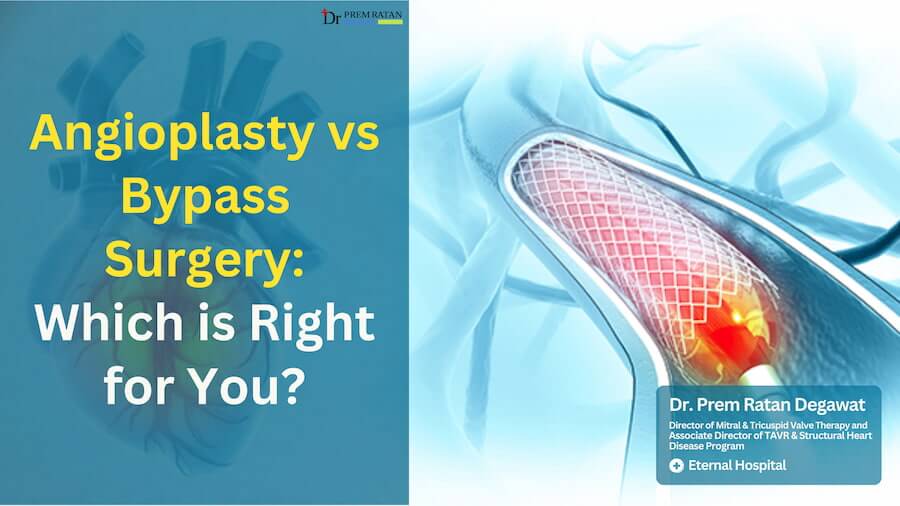
Angioplasty, also called PCI (Percutaneous Coronary Intervention), is a minimally invasive procedure. Your cardiologist inserts a thin catheter through your wrist or groin. A small balloon at the tip inflates to open the blocked artery. A stent (small mesh tube) is placed to keep the artery open.
For a detailed breakdown of the Coronary Angioplasty Surgery Cost in India, you can explore this comprehensive guide.
Key features:
- Minimally invasive (small incision)
- Takes 30 minutes to 2 hours
- Local anesthesia
- Hospital stay: 1-2 days
- Quick recovery
What is Bypass Surgery?
Bypass surgery (CABG – Coronary Artery Bypass Grafting) is open-heart surgery. The surgeon takes a healthy blood vessel from your leg, chest, or arm. This vessel creates a detour around the blocked artery. Blood flows through this new path to reach your heart.
Key features:
- Open-heart surgery (chest opened)
- Takes 3-6 hours
- General anesthesia
- Hospital stay: 5-7 days
- Longer recovery (6-12 weeks)
Angioplasty vs Bypass Surgery: Direct Comparison
Recovery Time
Angioplasty:
- Back home in 1-2 days
- Return to work in 1 week
- Normal activities in 2 weeks
- Full recovery in 4 weeks
Bypass Surgery:
- Hospital stay 5-7 days
- Return to work in 6-8 weeks
- Normal activities in 3 months
- Full recovery in 6 months
Winner: Angioplasty offers much faster recovery.
Invasiveness
Angioplasty:
- Small puncture in wrist or groin
- No chest opening
- Minimal scarring
- Less pain
- Lower infection risk
Bypass Surgery:
- Large chest incision
- Breastbone cut and wired back
- Significant scarring
- More post-operative pain
- Higher infection risk
Winner: Angioplasty is far less invasive.
Success Rates
Research shows both procedures have excellent outcomes when performed by experienced specialists.
Angioplasty:
- Procedural success: 95-99%
- 5-year survival: 86-91%
- Lower hospital mortality: 0.75-1.1%
- Effective for single and double vessel disease
Bypass Surgery:
- Procedural success: 95-98%
- 5-year survival: 89-91%
- Hospital mortality: 1.3-3.6%
- Better for complex multi-vessel disease
Verdict: Similar long-term survival rates. Choice depends on your specific condition.
Repeat Procedures
Angioplasty:
- 20-30% may need repeat procedure within 5 years
- Modern drug-eluting stents reduce this risk to less than 10%
- Repeat angioplasty is simple if needed
Bypass Surgery:
- 8-10% need additional procedures in 5 years
- Grafts can last 10-15 years or more
- Repeat bypass surgery is more complex
Winner: Bypass has slightly lower repeat rates, but modern stents have narrowed this gap significantly.
Cost Comparison
Angioplasty:
- Cost: ₹1,50,000 – ₹4,50,000
- Shorter hospital stay reduces costs
- Less time off work
- Lower overall expenses
Bypass Surgery:
- Cost: ₹3,00,000 – ₹8,00,000
- Longer hospital stay increases costs
- Extended recovery affects income
- Higher total costs
Winner: Angioplasty is significantly more affordable.
When is Angioplasty the Better Choice?
Modern angioplasty with drug-eluting stents works excellently for many patients. Consider angioplasty if you have:
Ideal candidates:
- Single or double vessel blockage
- Blockage that can be reached with catheter
- Need for quick recovery
- Want to avoid major surgery
- No severe diabetes with multiple blockages
- Good overall health
Advantages of angioplasty:
- Faster recovery – back to life quickly
- Minimal scarring and pain
- Lower immediate risks
- No heart-lung machine needed
- Can be repeated easily if needed
- Outpatient or overnight stay
- Lower costs
- Quick return to work
Studies show angioplasty offers similar survival rates to bypass surgery for many patients. The BARI trial found no significant difference in 5-year survival between angioplasty (86.3%) and bypass (89.3%) for most patients with multi-vessel disease.
When is Bypass Surgery Recommended?
Bypass surgery remains the gold standard for certain complex conditions. Consider bypass if you have:
Ideal candidates:
- Blockage in left main coronary artery
- Three-vessel disease (all three major arteries blocked)
- Severe diabetes with multi-vessel disease
- Previous failed angioplasty
- Complex blockages unsuitable for stenting
- Very small arteries that cannot be stented
- Severely weakened heart muscle
Advantages of bypass surgery:
- More complete revascularization
- Better for complex multi-vessel disease
- Longer-lasting results
- More durable in diabetic patients
- Better for left main artery blockage
Research shows bypass surgery offers survival benefits for high-risk patients. Those with diabetes and multi-vessel disease had better 5-year survival with bypass (80.6%) compared to angioplasty (65.5%).
Modern Angioplasty: Game-Changing Advances
Angioplasty has evolved dramatically. Today’s procedures offer results that rival bypass surgery for many patients.
Drug-Eluting Stents (DES)
Modern stents are coated with medication. This prevents scar tissue formation and reduces re-blockage risk.
Benefits:
- Re-blockage rate dropped from 40% to less than 5%
- Longer-lasting results
- Fewer repeat procedures needed
- Better outcomes than bare-metal stents
Advanced Techniques
Rotational Atherectomy: For heavily calcified blockages that balloons cannot open. A diamond-tipped drill gently removes hardened plaque.
Intravascular Ultrasound (IVUS): Real-time imaging inside the artery ensures perfect stent placement.
Fractional Flow Reserve (FFR): Measures actual blood flow to determine if stenting is needed.
Success in Complex Cases
Experienced interventional cardiologists now successfully treat:
- Chronic total occlusions (completely blocked arteries)
- Multi-vessel disease
- Bifurcation lesions (where arteries divide)
- Long blockages
The Hybrid Approach
Sometimes the best strategy combines both procedures. This is called staged or hybrid revascularization.
Example scenarios:
- Bypass for left main artery
- Angioplasty for other vessels
- Treat most critical blockage first
- Plan second procedure later
This approach maximizes benefits while minimizing risks.
Making Your Decision: Important Factors
Your cardiologist considers multiple factors when recommending treatment:
Medical Factors
Favoring angioplasty:
- Younger age
- Single or double vessel disease
- No diabetes or well-controlled diabetes
- Good heart function
- Recent heart attack (emergency situation)
Favoring bypass:
- Advanced age with multiple conditions
- Three-vessel disease
- Poorly controlled diabetes
- Weak heart muscle
- Previous failed angioplasty
Personal Factors
Consider angioplasty if:
- You want faster recovery
- Need to return to work quickly
- Prefer less invasive option
- Cannot tolerate major surgery
- Have family responsibilities
Consider bypass if:
- You prefer longer-lasting solution
- Can afford recovery time
- Want most complete treatment
- Have complex disease
Quality of Life
Studies show both procedures improve quality of life. However, angioplasty offers faster improvement.
Symptom relief:
- Angioplasty: Immediate to 1 week
- Bypass: 6-8 weeks
Return to activities:
- Angioplasty: 2-4 weeks
- Bypass: 3-6 months
Why Choose Dr. Prem Ratan Degawat
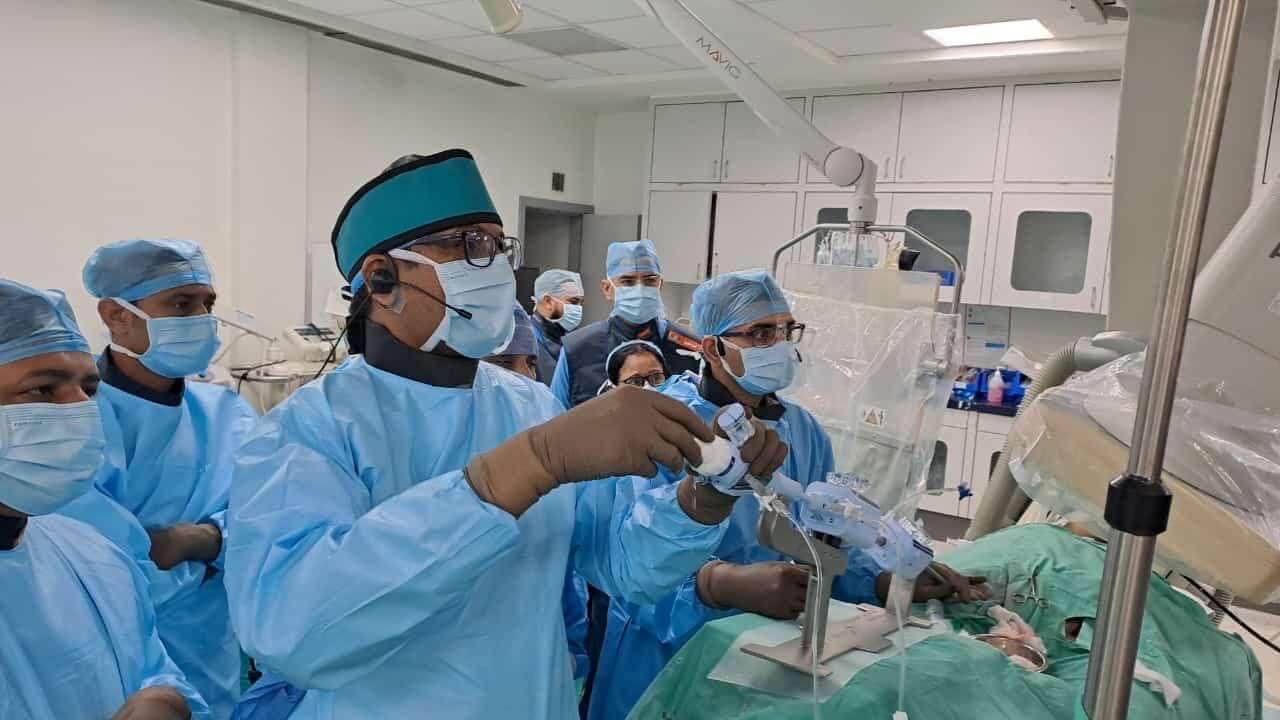
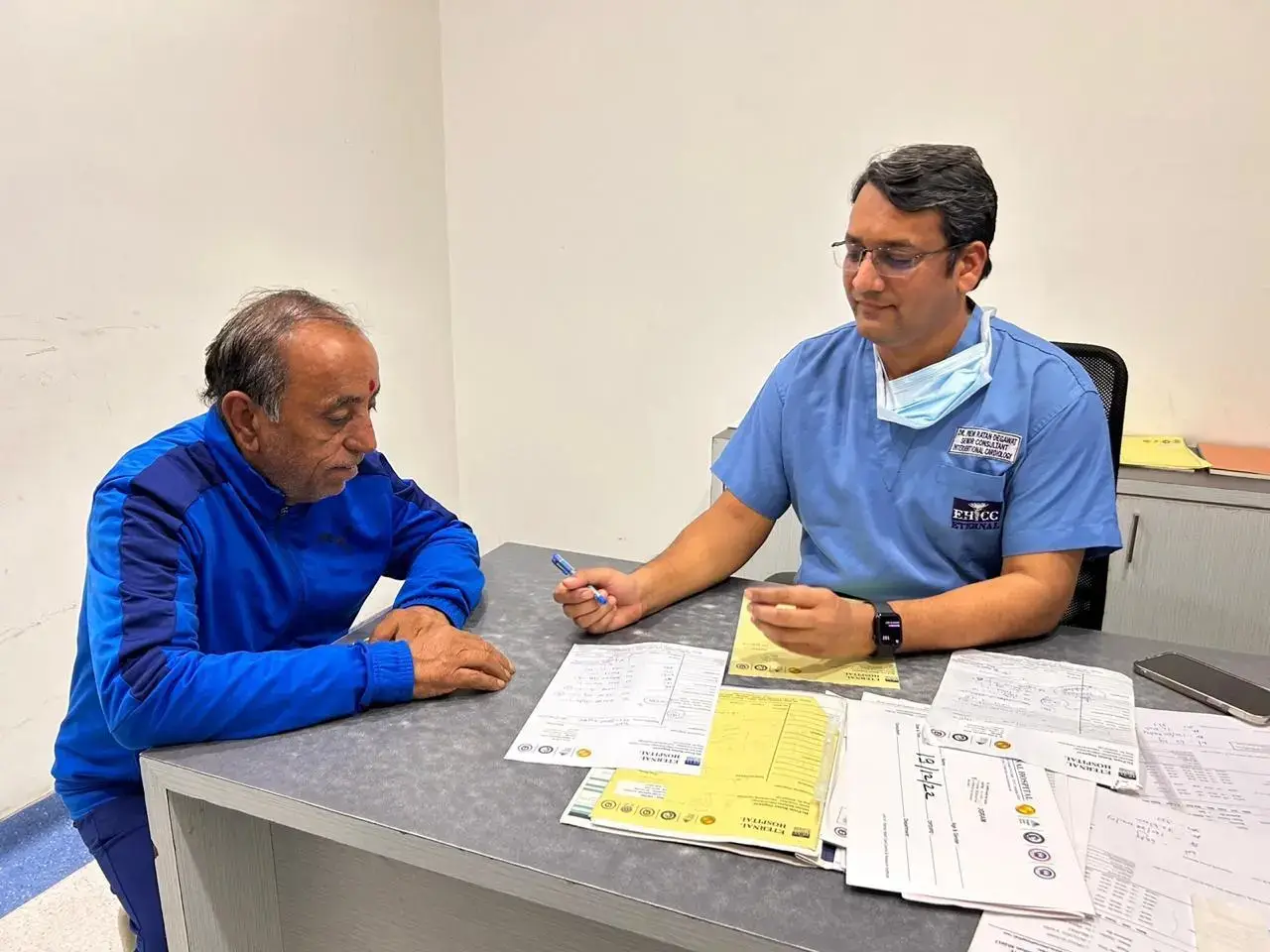
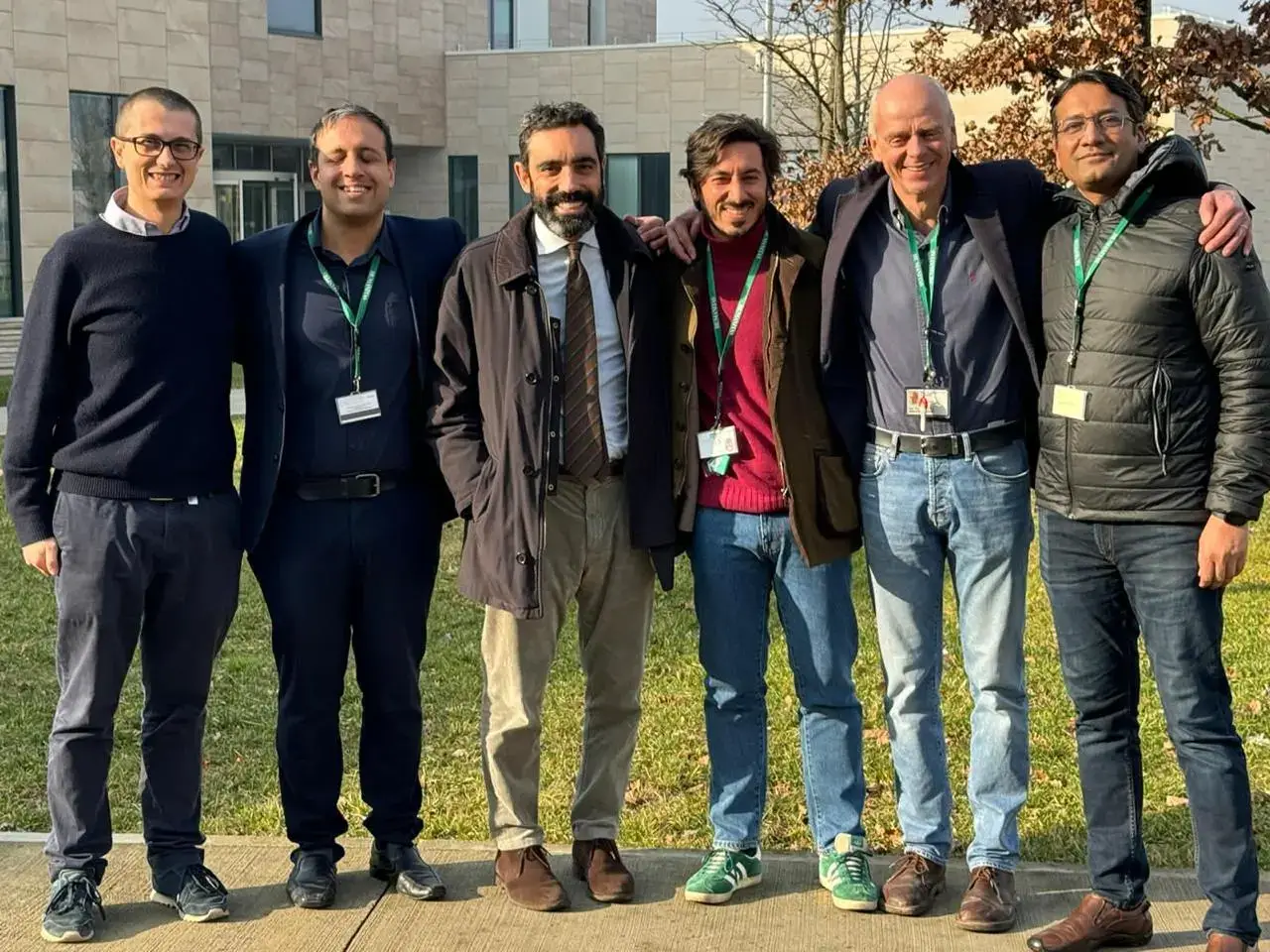
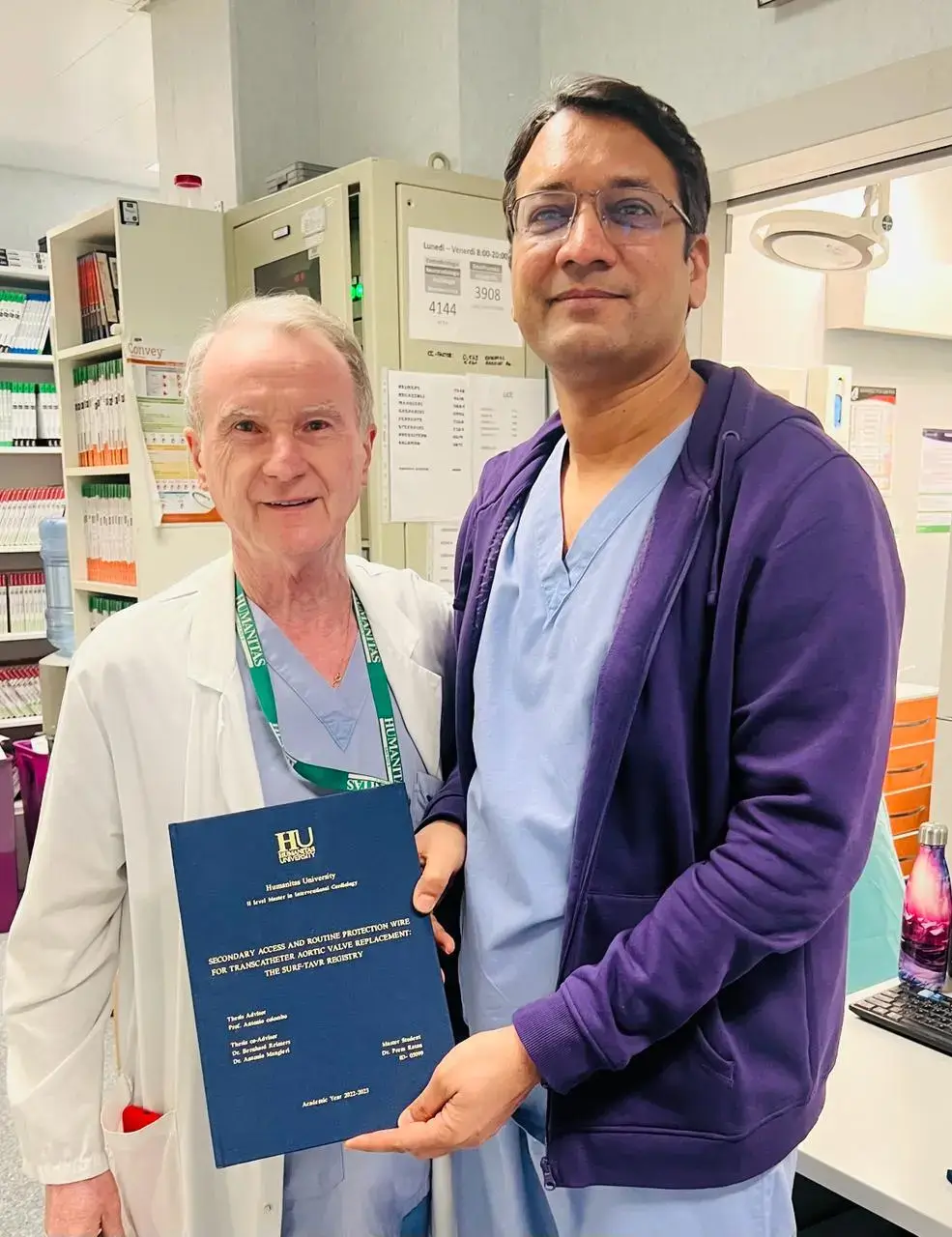
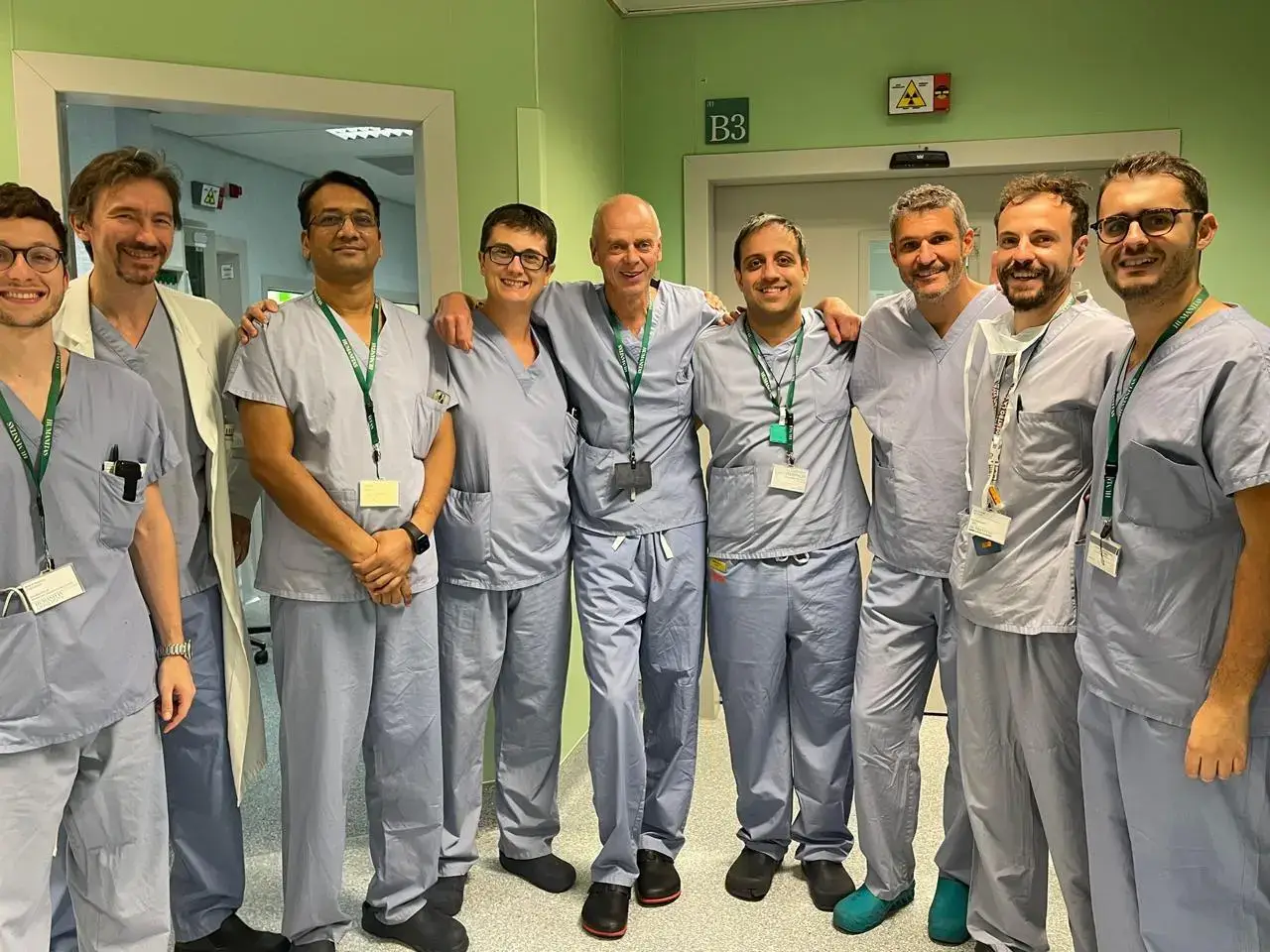
Expertise matters when choosing between treatments. Dr. Prem Ratan Degawat offers comprehensive cardiac care in Jaipur.
Expert in Both Approaches
Angioplasty expertise:
- 15+ years of interventional cardiology experience
- Thousands of successful procedures
- 99% success rate
- Advanced complex angioplasty specialist
- Latest techniques including rotational atherectomy
Comprehensive cardiac services:
- Primary angioplasty for heart attacks
- Complex multi-vessel angioplasty
- Chronic total occlusion treatment
- Advanced valve procedures – TAVI
- MitraClip therapy
Patient Testimonials
Patients from across India and abroad choose Dr. Degawat for cardiac care. His combination of technical expertise and compassionate care has helped thousands recover successfully.
Questions to Ask Your Cardiologist
Before deciding, discuss these points with your doctor:
- How many vessels are blocked?
- Where exactly are the blockages?
- Am I a candidate for both procedures?
- What are success rates for my specific case?
- What are the risks with each option?
- How long will recovery take?
- Will I need repeat procedures?
- What are the costs involved?
- What is your experience with both procedures?
- What would you recommend and why?
The Bottom Line: Which is Better?
There’s no single “better” option. The right choice depends on your individual situation.
Choose angioplasty if:
- You have single or double vessel disease
- Blockages are accessible with catheter
- You want faster recovery
- You prefer less invasive treatment
- Cost is a major concern
Choose bypass if:
- You have three-vessel disease
- Left main artery is blocked
- You have severe diabetes with multiple blockages
- Previous angioplasty failed
- Your cardiologist recommends it
Good news: Both procedures have excellent success rates when performed by experienced specialists like Dr. Degawat.
Take Action for Your Heart Health
Don’t delay treatment if you’ve been diagnosed with coronary artery disease. Both angioplasty and bypass surgery can save your life and dramatically improve your quality of life.
Schedule Your Consultation
Dr. Prem Ratan Degawat offers comprehensive evaluation to determine the best treatment for you:
What to expect:
- Thorough review of your condition
- Discussion of all available options
- Honest recommendations based on evidence
- No pressure – informed decision-making
- Transparent cost counseling
- World-class care in Jaipur
Contact Dr. Degawat’s clinic today. Your heart deserves expert care and the treatment that’s truly right for you.
Frequently Asked Questions (FAQs)
1. Which is better – angioplasty or bypass surgery?
Neither is universally “better.” Angioplasty works excellently for single or double vessel disease with faster recovery. Bypass is better for three-vessel disease, left main blockage, or severe diabetes with multiple blockages. Your specific condition determines the best choice.
2. Is angioplasty safer than bypass surgery?
Angioplasty has lower immediate risks with hospital mortality of 0.75% vs 1.3-3.6% for bypass. However, long-term survival rates are similar. Angioplasty is less invasive with faster recovery and fewer complications.
3. How long do angioplasty results last?
Modern drug-eluting stents last many years. Less than 10% of patients need repeat procedures within 5 years. With proper medications and lifestyle changes, results can last 10-15 years or longer.
4. Can I have angioplasty instead of bypass for three-vessel disease?
Sometimes, yes. Recent studies show selected patients with three-vessel disease can have excellent outcomes with angioplasty. However, bypass may be better if you have diabetes, left main disease, or very complex blockages. Discuss with your cardiologist.
5. What is the recovery time for angioplasty vs bypass?
Angioplasty: Home in 1-2 days, normal activities in 2 weeks, full recovery in 4 weeks. Bypass: Hospital 5-7 days, normal activities in 3 months, full recovery in 6 months. Angioplasty offers significantly faster recovery.
6. Is angioplasty cheaper than bypass surgery in India?
Yes. Angioplasty costs ₹1.5-4.5 lakh while bypass costs ₹3-8 lakh. Plus, shorter hospital stay, faster recovery, and quicker return to work make angioplasty more economical overall.
7. Can angioplasty be done again if blockage returns?
Yes. Repeat angioplasty is simpler than initial bypass surgery. With modern drug-eluting stents, re-blockage rates are below 10%. If needed, repeat angioplasty has high success rates.
8. Why choose Dr. Degawat for heart treatment in Jaipur?
Dr. Degawat offers 15+ years of experience, 99% success rates, advanced techniques including complex angioplasty and TAVI, state-of-the-art facilities, transparent pricing, and personalized care. He provides metro-city expertise at Jaipur’s affordable costs.