Medically reviewed by Dr. Prem Ratan Degawat, MD, DM (Cardiology)
Senior Interventional Cardiologist · Director, Mitral & Tricuspid Valve Therapy · Associate Director, TAVR & Structural Heart Disease Program, Eternal Hospital, Jaipur
Last updated on April 4, 2026 · View LinkedIn profile
What Is Tricuspid Regurgitation?
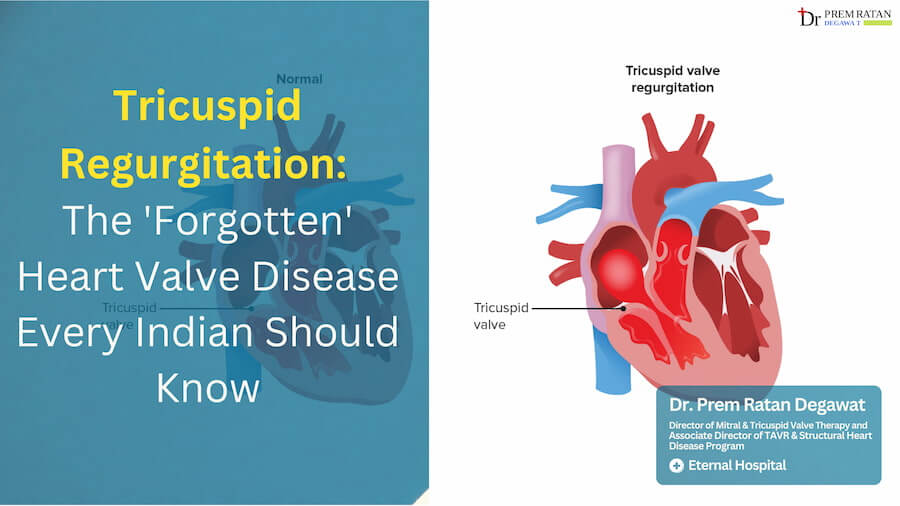
Tricuspid regurgitation occurs when the tricuspid valve—located between the right atrium and right ventricle—fails to close properly, allowing blood to flow backward into the right atrium during each heartbeat.
While mild tricuspid regurgitation is present in 80-90% of the general population, it becomes problematic when moderate to severe. Research shows that significant tricuspid regurgitation affects 14.8% of adult men and 18.4% of adult women.
Why Was It Called the “Forgotten Valve”?
For decades, doctors believed tricuspid regurgitation would resolve on its own once left-sided heart problems were treated. This outdated thinking led to countless patients going untreated. Modern research proves this approach is dangerous—66% of patients with severe functional tricuspid regurgitation die within 5 years with medical management alone.
Types of Tricuspid Regurgitation
1. Functional (Secondary) Tricuspid Regurgitation- 90% of Cases
The valve leaflets are normal, but the valve doesn’t close because:
- Heart enlargement stretches the valve opening
- Right ventricle dysfunction
- Pulmonary hypertension
- Left-sided heart disease (mitral valve problems, heart failure)
2. Primary (Organic) Tricuspid Regurgitation- 10% of Cases
Direct damage to the valve from:
- Rheumatic fever (most common in patients over 15 in India)
- Pacemaker lead damage (increasingly common)
- Infective endocarditis
- Congenital abnormalities (Ebstein’s anomaly)
- Trauma or injury
Symptoms: When to Suspect Tricuspid Regurgitation
Mild TR: Often No Symptoms
Many people live with mild tricuspid regurgitation without knowing it.
Moderate to Severe TR:
Right-Sided Heart Failure Signs:
- Swelling in legs, ankles, and feet (edema)
- Abdominal swelling (ascites)
- Enlarged, pulsating neck veins
- Enlarged, tender liver
General Symptoms:
- Extreme fatigue and weakness
- Shortness of breath with minimal activity
- Reduced exercise tolerance
- Irregular heartbeat (atrial fibrillation)
- Loss of appetite
- Frequent urination at night
Warning: These symptoms develop gradually over years, making early detection difficult.
Who Is at Risk?
High-Risk Groups in India:
1. Patients with Rheumatic Heart Disease Childhood rheumatic fever can damage the tricuspid valve decades later
2. People with Pacemakers or ICDs Device leads can cause mechanical interference with the valve or induce right ventricular dysfunction
3. Left-Sided Valve Disease Patients Mitral valve problems often lead to secondary tricuspid regurgitation
4. Heart Failure Patients Both preserved and reduced ejection fraction
5. Older Adults Prevalence reaches 7% in those aged over 75 years
6. Women More prevalent in females than males
Diagnosis: How Is It Detected?
Physical Examination
Your doctor listens for:
- A specific whooshing sound (systolic murmur) at the lower left chest
- Enlarged liver pulsating with heartbeat
- Visible jugular vein pulsations in neck
Essential Tests
Echocardiogram (Echo)—Gold Standard:
- Shows how well the valve closes
- Measures regurgitation severity (mild, moderate, severe)
- Assesses right heart size and function
- Evaluates pulmonary pressure
ECG (Electrocardiogram): Detects atrial fibrillation and right atrial enlargement
Chest X-ray: Shows heart enlargement
Cardiac MRI: Provides detailed images of valve and heart chambers
Right Heart Catheterization: Measures pressures inside heart chambers
Treatment Options: From Medical Management to TriClip
For Mild to Moderate TR:
Medications:
- Diuretics (water pills) to reduce fluid retention
- Blood pressure medications
- Rhythm control drugs for atrial fibrillation
- Blood thinners to prevent clots
Lifestyle Modifications:
- Low-sodium diet (less than 2,000 mg daily)
- Fluid restriction if advised
- Regular monitoring
For Severe TR: Advanced Interventions
1. TriClip Procedure—Revolutionary Minimally Invasive Treatment
The TriClip is a game-changing transcatheter edge-to-edge repair (TEER) specifically designed for the tricuspid valve. At 2 years, TriClip TEER reduced the risk of heart failure hospitalization by 28% relative to medical therapy alone.
How TriClip Works:
- A small clip is delivered through a vein in your leg
- No open-heart surgery needed
- Clips bring valve leaflets together
- Reduces blood leakage
- Entire procedure done on beating heart
Benefits:
- Minimally invasive—no chest opening
- 2-3 day hospital stay
- Quick recovery (1-2 weeks)
- Improves quality of life significantly
- Reduces symptoms of heart failure
- Safe for high-risk patients who can’t undergo surgery
Success Rates: 85.4% of patients showed TR reduction at 30 days, maintained at 2 years
2. Surgical Tricuspid Valve Repair
When Considered:
- During other heart surgery (mitral valve, coronary bypass)
- Younger patients with isolated primary TR
- When valve structure allows repair
Techniques:
- Ring annuloplasty (placing a ring to tighten valve)
- Leaflet repair
- Chord repair or replacement
3. Tricuspid Valve Replacement
Reserved for severely damaged valves that can’t be repaired:
- Mechanical valve (lasts lifetime, needs blood thinners)
- Biological valve (lasts 10-15 years, less blood thinner dependency)
4. PASCAL System
Another transcatheter option similar to TriClip, showing TR reduction to less than 2+ in 77% of patients.
Why Early Treatment Matters
Untreated Severe TR Leads To:
- Progressive right heart failure
- Irreversible liver and kidney damage
- Increased mortality risk
- Severely reduced quality of life
- Frequent hospitalizations
The Treatment Gap: Most patients receive medical management until right heart failure or end-organ dysfunction appears, by which time the damage may be irreversible. Early intervention with TriClip can prevent this progression.
Dr. Prem Ratan Degawat: Pioneer in Tricuspid Valve Treatment in Jaipur
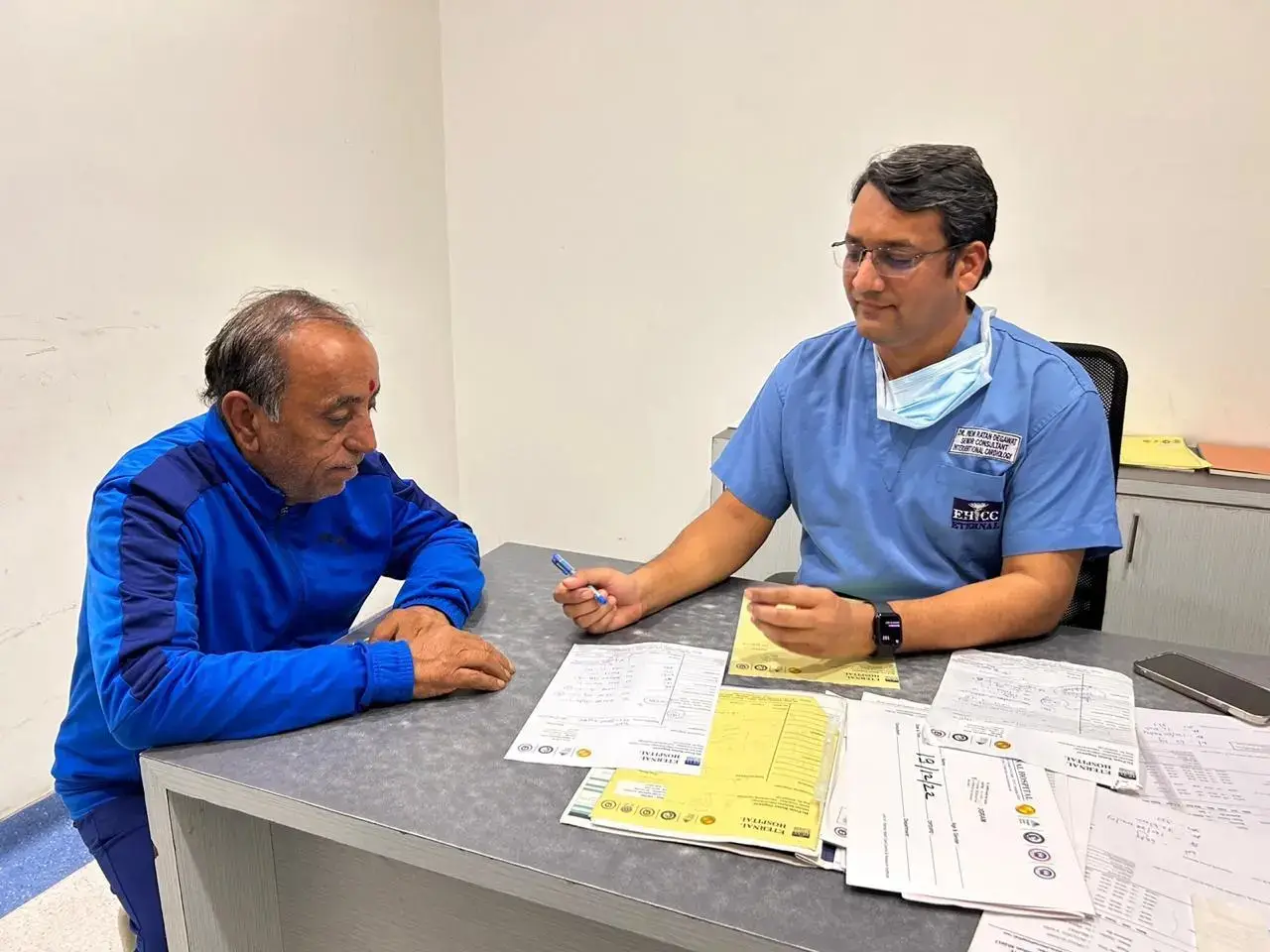
Dr. Prem Ratan Degawat is among the select few cardiologists in India trained and experienced in advanced tricuspid valve interventions, including the revolutionary TriClip procedure.






Specialized Expertise
Advanced Training:
- Fellowship in Structural Heart Disease & TAVR from IRCCS Policlinico San Donato, Milan, Italy
- D.M. in Cardiology with focus on complex valve interventions
- Certified in transcatheter tricuspid valve repair (TriClip/TEER)
Comprehensive Tricuspid Valve Services:
- TriClip Transcatheter Edge-to-Edge Repair
- PASCAL System for tricuspid repair
- Transcatheter tricuspid valve replacement
- Complete diagnostic evaluation with 3D echocardiography
- Right heart catheterization
Why Choose Dr. Degawat for Tricuspid Valve Treatment?
1. Multidisciplinary Heart Team Approach Collaboration between interventional cardiologists, cardiac surgeons, and imaging specialists ensures the best treatment plan for each patient.
2. Minimally Invasive First Prioritizes less invasive options like TriClip when appropriate, reducing recovery time and risks.
3. Comprehensive Care From diagnosis through treatment and long-term follow-up.
4. Advanced Imaging State-of-the-art 3D echocardiography for precise valve assessment.
5. Patient-Centered Philosophy Thorough explanation of all options, risks, and benefits.
When to Consult Dr. Degawat:
Immediate Evaluation Needed If:
- Diagnosed with moderate or severe tricuspid regurgitation
- Experiencing swelling in legs, abdomen, or liver area
- Severe fatigue limiting daily activities
- Shortness of breath with minimal exertion
- History of rheumatic heart disease
- Pacemaker or ICD with new symptoms
- Scheduled for left-sided heart surgery
Living with Tricuspid Regurgitation: Lifestyle Management
Dietary Guidelines
Reduce Sodium:
- Limit to less than 2,000 mg daily
- Avoid processed foods, canned soups, salty snacks
- Read nutrition labels carefully
Fluid Management:
- Follow doctor’s fluid restriction if advised
- Monitor daily weight
- Report sudden weight gain (2+ kg in 2-3 days)
Heart-Healthy Foods:
- Fresh fruits and vegetables
- Whole grains
- Lean proteins
- Low-fat dairy
Activity Recommendations
Safe Exercises:
- Walking (as tolerated)
- Light yoga
- Swimming (once cleared)
Avoid:
- Heavy lifting
- High-intensity competitive sports
- Straining activities
Regular Monitoring
Essential Follow-ups:
- Annual or biannual echocardiograms
- Monitor for symptom changes
- Track weight daily
- Check blood pressure regularly
Schedule Your Consultation Today
Don’t let tricuspid regurgitation remain forgotten. Take control of your heart health today.
FAQs
1. Is tricuspid regurgitation serious?
Mild TR is common and usually benign. However, moderate to severe TR can lead to right heart failure, liver damage, and significantly increased mortality if left untreated. 66% of patients with severe functional TR die within 5 years without proper intervention.
2. Can tricuspid regurgitation be cured without surgery?
Yes! The TriClip procedure offers a minimally invasive, non-surgical solution for severe tricuspid regurgitation. It’s performed through a small catheter inserted in the leg vein, with no chest opening required. Recovery is much faster than traditional surgery.
3. What is the success rate of TriClip for tricuspid regurgitation?
TriClip shows excellent results. Studies show 85.4% of patients had significant TR reduction at 30 days, which was maintained at 2 years. Additionally, it reduces heart failure hospitalization risk by 28% compared to medication alone.
4. How long does recovery take after TriClip procedure?
Most patients stay in hospital for 2-3 days and can return to normal activities within 1-2 weeks. This is dramatically faster than the 6-8 weeks required after open-heart surgery.
5. Am I a candidate for TriClip if I have a pacemaker?
Possibly. While pacemaker leads can cause tricuspid regurgitation, TriClip may still be an option depending on lead position and valve anatomy. A comprehensive evaluation by a structural heart specialist like Dr. Degawat is essential to determine candidacy.
6. Does insurance cover TriClip procedure in India?
Most comprehensive health insurance policies in India cover advanced cardiac procedures including TriClip. Coverage typically ranges from ₹4-8 lakhs. Check with your insurance provider and the hospital’s insurance desk for specific details and pre-authorization requirements.
7. Can tricuspid regurgitation come back after treatment?
With TriClip, durability data shows sustained reduction in TR severity at 2 years. However, ongoing medical management, lifestyle modifications, and regular follow-up remain essential to maintain results and prevent progression.
Medical Disclaimer: This content is for informational purposes only and does not constitute medical advice. Always consult with qualified healthcare professionals for diagnosis and treatment of heart valve conditions.